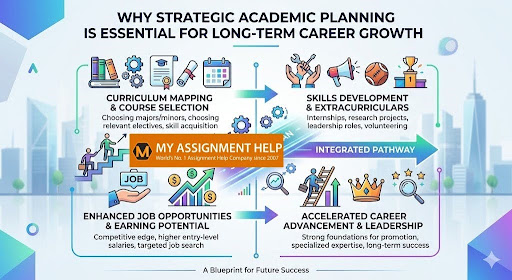
The transition from high school to higher education, and ultimately into the highly competitive professional workforce, is rarely a straight line. For modern students across the United States, the career landscape is shifting faster than ever before. Entire industries are being transformed overnight by technological disruption, digital literacy standards are escalating exponentially, and the global job market demands highly dynamic, adaptive skill sets.
In this hyper-competitive environment, wandering through your education without a clear roadmap is no longer just a passive choice—it is a significant risk to your professional future. Academic planning is not merely about choosing next semester’s classes, avoiding early morning lectures, or checking off institutional graduation requirements. It is a foundational exercise in career strategy. By actively aligning your education with your long-term career goals, you build a resilient, future-proof framework for sustained professional success.
1. What Is Strategic Academic Planning for College and Career Success?
At its core, contemporary academic planning is the strategic process of aligning your educational milestones—degrees, certifications, coursework, independent research, and extracurricular activities—with your ultimate career aspirations. It requires looking far beyond the immediate academic term and analyzing how each choice influences your future marketability to employers.
Effective academic planning involves a continuous loop of deep self-reflection and rigorous market research. It requires asking critical questions before locking in a syllabus:
- What macroeconomic and industry trends will define the workforce five to ten years from now?
- What specific core competencies, technical capabilities, and leadership traits do employers look for in high-trajectory roles?
- How can a general or traditional degree be optimized through targeted specializations, cross-departmental electives, and micro-credentials?
For US high school students looking ahead to college success, this means selecting Advanced Placement (AP) courses or International Baccalaureate (IB) modules that translate into university credits or demonstrate academic rigor to admissions committees. For university undergraduates and postgraduate students, it involves crafting a highly customized curricular profile that blends academic theory with practical, marketable skills. It transforms the student from a passive recipient of a curriculum into an active architect of their professional identity.
2. How to Reverse Engineer Your College Major for Maximum Impact
One of the most effective strategic frameworks used by corporate management consultants and academic strategists alike is reverse engineering. Instead of looking forward from where you are today and wondering where your major might take you, you look at where you want to be in ten years, and chart a meticulously detailed path backward to the present day.
If your long-term goal is to lead an innovative sector, a standard, generalized degree will rarely suffice. You must dissect the biographies of current industry leaders and top executives. What did they study? What foundational skills do they possess? What specific professional milestones did they hit in their twenties?
By identifying the strict prerequisites of your dream job, you can make informed, data-driven decisions about your current academic path. This ensures that every elective chosen, every research paper written, and every academic project undertaken serves as an intentional building block for your ultimate professional portfolio.
You stop collecting credits and start building assets. Navigating this high-level synthesis can be challenging, which is why many students utilize professional assignment writing services at Myassignmenthelp.com to analyze complex case studies and maintain a pristine academic record while focusing on long-term strategy. This shift in mindset prevents the common post-graduation trap of holding a degree but lacking the specific portfolio required to cross the threshold into entry-level career tracks.
3. How to Build a Skill Stack in College to Stand Out to US Employers
The modern workforce rarely rewards professionals who possess only one distinct skill. Instead, the most resilient, high-paying careers are built on a concept known as Skill Stacking. This involves combining complementary, diverse competencies to create a unique, highly competitive professional profile that is difficult for automated systems or outsourcing to replace.
Academic planning provides the ideal sandbox for designing your personal skill stack. Rather than focusing exclusively on your major, a well-structured academic roadmap incorporates minors, certificate programs, and cross-departmental electives to diversify your capabilities.
Consider a student majoring in Business Administration. A standard business degree is valuable, but it is also highly common. Now, imagine that student applies strategic academic planning to systematically stack their skills:
- The Core Major: Business Administration (Providing foundational knowledge in corporate finance, operational management, and organizational strategy).
- The Strategic Minor: Data Analytics or Computer Science (Providing the technical ability to clean, interpret, and manipulate complex, large-scale data sets).
- The Elective Focus: Digital Skills, Technical Communication, and User Experience Design (Ensuring they can translate complex technical data into actionable, human-centric business insights for executives).
For those pursuing postgraduate management tracks, balancing these technical layers with advanced leadership theory requires flawless execution; tapping into a specialized mba assignment writing service can help master corporate governance and strategic framework modeling.
Ultimately, this student is no longer just a business graduate competing against thousands of identical resumes; they are a data-driven business strategist capable of bridging the gap between technical engineering teams and C-suite leadership. Strategic academic planning allows you to intentionally engineer this exact competitive edge.
4. How to Maximize Your Higher Education ROI and Reduce Student Debt
Higher education is one of the most significant financial and temporal investments an individual will ever make. With rising tuition costs across the United States, treating your education as a passive, experiential journey is a monumental missed opportunity. Academic planning is your primary mechanism for maximizing your educational Return on Investment (ROI).
When you operate with a clear, vetted academic roadmap, you minimize structural inefficiencies that cost both time and money:
Avoiding Excess Credits
Unplanned changes in majors or unvetted elective choices often result in taking classes that do not contribute to graduation or career alignment. In the US higher education system, accumulating excess credits can lead to extending graduation timelines by a semester or a full year, dramatically increasing student loan dependencies.
Accelerated Pathways
Structured planning allows you to identify dual-degree programs, accelerated master’s tracks (such as 4+1 programs), or opportunities to test out of introductory material via prior learning assessments, CLEP exams, or high school AP/IB credits.
Targeted Resource Allocation
When you know your exact academic and career trajectory, you can strategically seek out institutional resources—such as specialized research labs, targeted faculty mentorships, and industry-specific career fairs—long before graduation approaches. This proactive approach ensures you maximize every dollar spent on campus infrastructure.
5. How to Balance College Coursework and Internships Effectively
A degree alone is rarely enough to secure a high-trajectory role upon graduation. US employers expect a potent combination of academic rigor and real-world application. A comprehensive academic plan treats experiential learning not as an extracurricular afterthought, but as a core, unskippable component of the curriculum.
Your academic roadmap should explicitly schedule space for:
- Internships and Co-ops: Aligning your academic terms to accommodate competitive summer or semester-long internships in your target industry without delaying your graduation date.
- Undergraduate Research: Partnering with faculty members on research initiatives that develop advanced analytical, professional writing, and complex problem-solving capabilities.
- Extracurricular Leadership: Selecting student organizations, academic clubs, or community initiatives where you can actively practice project management, budgeting, and team leadership.
By treating these activities as vital milestones within your academic plan, you ensure that your resume displays a narrative of consistent, practical achievement alongside a high GPA.
6. Utilizing Evidence Based Productivity Methods for High-Achieving Students
Managing a dense academic plan that requires rigorous coursework, deep research, and rapid skill acquisition forces students to adopt sophisticated time-management and self-regulation frameworks. Successful execution relies on established, evidence-based productivity methodologies.
Deep Work & The Pomodoro Technique
High-output students structure long blocks of uninterrupted cognitive focus—a practice known as Deep Work—to tackle complex problem sets or heavy writing assignments. To maintain mental stamina, these deep sessions are paired with the Pomodoro Technique, interspersing focused work intervals (typically 25 to 50 minutes) with deliberate recovery phases. Mastering these workflows early ensures you can effortlessly handle the high-pressure demands of modern corporate or academic environments.
Cognitive Mastery & Learning How to Learn
The rapid pace of modern industry requires constant upskilling. Academic planning teaches you to treat learning as a systematic process rather than an innate talent. Utilizing cognitive frameworks such as the Feynman Technique (demystifying complex concepts by explaining them in simple, layman terms) and active retrieval methods like the Leitner System (using spaced repetition to master dense theoretical frameworks) prepares you to quickly absorb new systems, compliance protocols, and emerging operational strategies throughout your career.
Strategic Leverage and Academic Support Ecosystems
Top-tier professionals understand that productivity isn’t just about working harder; it’s about strategic delegation and leveraging expert support ecosystems. When balancing dense credit loads, job hunts, and deep research parameters, high-achieving students utilize trusted academic tools to protect their mental bandwidth.
Myassignmenthelp.com serves as vital operational assets within a student’s productivity stack. By utilizing professional resources for expert editing, structural modeling, and comprehensive coursework guidance, students can offload time-consuming structural bottlenecks. This strategic delegation preserves invaluable cognitive energy, allowing students to maintain a top-tier GPA while dedicating their primary focus to high-level networking, internship acquisition, and hands-on skill cultivation.
Frequently Asked Questions
Q.1 When should you start academic planning for college and career success?
The ideal timeline to begin academic planning is during the freshman or sophomore year of high school. Starting early allows you to map out crucial prerequisite courses, select GPA-boosting AP/IB tracks, and space out extracurricular commitments. For non-traditional or university students, academic planning should begin the moment you enroll in an institution to optimize your credit distribution and secure hyper-competitive summer internships.
Q.2 Can I change my academic plan if my career interests shift?
Absolutely. An effective academic plan is designed to be a dynamic roadmap, not a rigid script. The frameworks built into academic planning—such as Skill Stacking—actually make pivoting easier. Because you have focused on accumulating versatile digital skills and cross-departmental electives, your underlying core competencies can easily be transferred and re-aligned to a new industry major or minor without losing structural credit momentum.
Q.3 What is the difference between a graduation checklist and a strategic academic plan?
A graduation checklist is a passive institutional document that outlines the bare minimum credits required to earn a degree. A strategic academic plan is an active, personalized career strategy. It goes beyond mandatory coursework to explicitly integrate micro-credentials, targeted faculty mentorships, sequential internships, and evidence-based productivity workflows tailored entirely to maximizing your post-graduate ROI.
Conclusion: Take Control of Your Educational Narrative
Your academic journey is the definitive blueprint for your professional future. It is the formative period where you transform from a passive consumer of information into an active, intentional designer of your own career trajectory.
Do not leave your professional development to chance or wait until graduation to begin thinking about your marketability in the US economy. Begin building your academic plan today. Research your target industries, build your personal skill stack, master advanced learning frameworks, and lean on expert academic support systems when necessary. By taking control of your educational narrative now, you lay the foundational groundwork for sustained, long-term career growth.
About the Author:
I am a dedicated blog author associated with Myassignmenthelp.com, known for creating informative and student-focused educational content. My blogs mainly cover assignment guidance, academic writing tips, productivity strategies and higher education trends. Through my engaging writing style, I aim to help students manage academic challenges effectively while improving their learning experience and overall academic performance with practical and reliable insights.
Stay in touch to get more updates & news on Sarah Hadland!